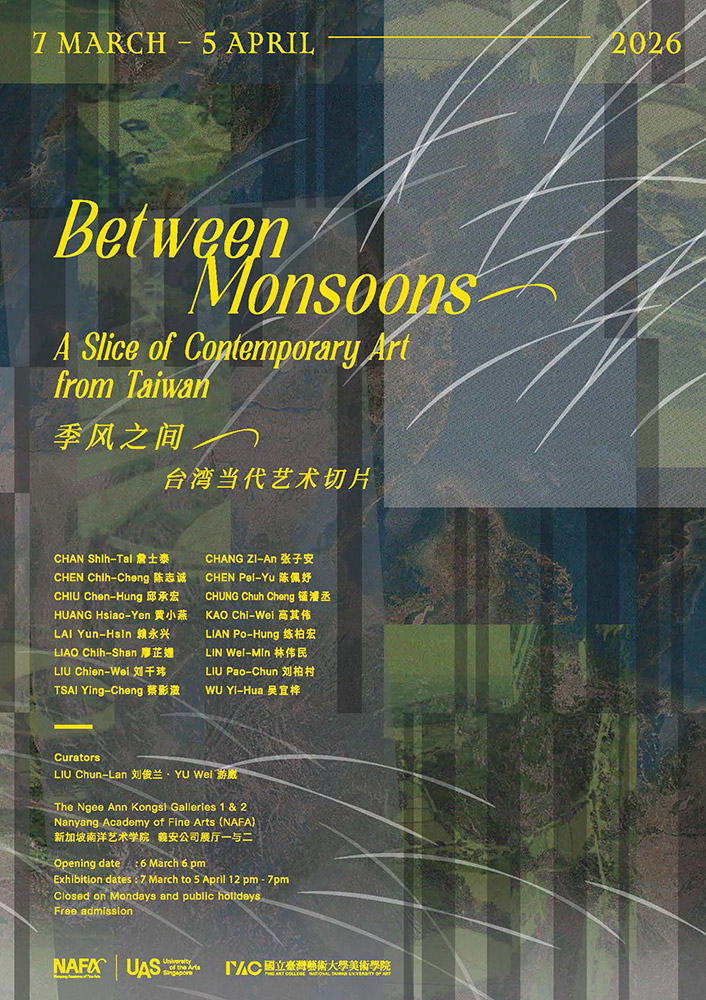
Monsoon comes from the Arabic word mawsim, meaning “season” or an appointed time. It first referred to the marking of time before it became a meteorological term. Over time, the word was used to describe the cyclical reversal of winds and rains. These seasonal changes shaped patterns of seafaring, migration and cultural exchange across different regions.
However, the monsoon is more than a weather system. It also suggests delay and persistence. The philosopher Henri Bergson described this as durée, a lived and non-linear experience of time. We feel this most clearly in the damp cold of winter, when the chill lingers on the skin and refuses to lift. This is a familiar sensation for those in Taiwan, which sits between the tropical and subtropical zones within the East Asian monsoon system.
By referring to the monsoon, this exhibition explores how time, rhythm and lived bodily experience, shaped by specific climatic conditions, influence artistic sensibilities in Taiwan. Here, the monsoon becomes a metaphor for artistic practice itself. Creative journeys continue to unfold, return and shift over time.
Offering a slice of contemporary art from Taiwan, Between Monsoons gathers sixteen artists from the Departments of Sculpture and Fine Arts at the College of Fine Arts, National Taiwan University of Arts—faculty and students spanning Taiwan’s postwar second generation to creators born after the millennium. Their works may be read as varied “monsoon texts,” revealing open-ended, polysemic, hybrid explorations.
Co-organized by National Taiwan University of Arts’ College of Fine Arts and Nanyang Academy of Fine Arts, this exhibition forms part of an exchange program initiated by the two institutions in 2025. Taiwan and Singapore both lie within the monsoon belt, sharing a common climatic foundation. Through movement, circulation, and encounters across latitudes, Between Monsoons offers a space where their vibrant artistic cultures may be shared across the waters.